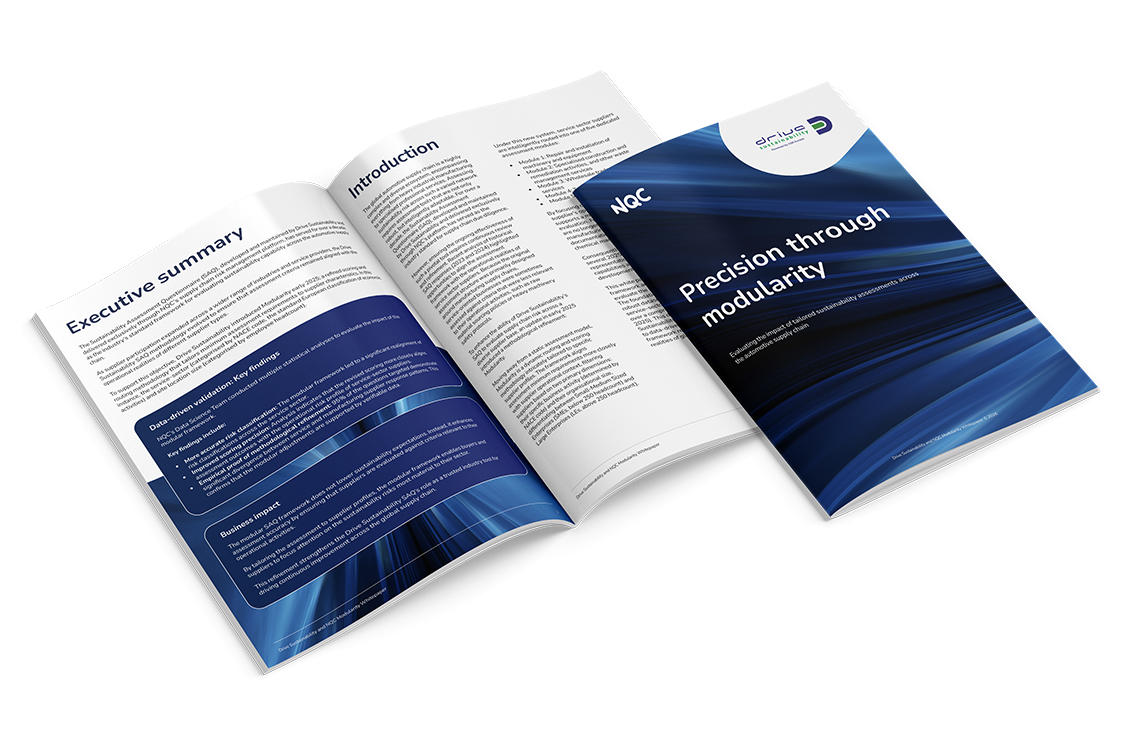
Precision through modularity

Evaluating the impact of tailored sustainability assessments

As supplier participation expanded across a wider range of industries and service providers, the Drive Sustainability SAQ methodology evolved to ensure that assessment criteria remained aligned with the operational realities of different supplier types.

To support this objective, Drive Sustainability introduced Modularity early 2025; a refined scoring and routing methodology that tailors minimum assessment requirements to supplier characteristics. In this instance, the service-sector (categorised by NACE code, the standard European classification of economic activities) and site location size (categorised by employee headcount).


The Sustainability Assessment Questionnaire (SAQ), developed and maintained by Drive Sustainability and delivered exclusively through NQC’s supply chain risk management platform, has served for over a decade as the industry’s standard framework for evaluating sustainability capability across the automotive supply chain.

Evaluate the impact of the modular framework

Complete the form to download the white paper.

A data-driven view of automotive supply chain sustainability

Sustainability expectations across global supply chains are rising rapidly. Regulations such as the EU Corporate Sustainability Due Diligence Directive (CSDDD), the EU Deforestation Regulation (EUDR), and expanding human rights legislation are increasing pressure on companies to understand and manage supplier risk more effectively.

The 2026 Supply Intelligence Report draws on more than 60,000 responses to the Sustainability Assessment Questionnaire (SAQ), the industry standard assessment created and maintained by Drive Sustainability and delivered exclusively through the NQC platform.

The SAQ evaluates supplier capability across key sustainability areas including human rights, environmental compliance, supply chain management, and business ethics.

Aligning Compliance paths with Operational Reality

Strategic focus

Discover how moving away from a static compliance model allows organisations to consider the specific operational context of individual partners without lowering sustainability expectations across the network.  

The global automotive supply chain is a complex ecosystem encompassing everything from heavy industrial manufacturing to specialised professional services. For over a decade, the Drive Sustainability SAQ, delivered exclusively through NQC's platform, has served as the trusted industry tool for supply chain due diligence.

As supplier participation expanded across a wider range of service providers, standard static assessment models sometimes evaluated service-oriented businesses against criteria less relevant to their actual operations. To enhance evaluation accuracy, Drive Sustainability introduced Modularity—a refined scoring and dynamic routing framework intricately tailored to specific supplier profiles.

Organisations utilizing this refined methodology benefit from a highly targeted approach that customises minimum assessment requirements based on two primary dimensions: specific business activity (NACE economic classification codes) and organisational size (site location employee headcount).

By focusing metrics strictly on each supplier's operational activities, the modular framework supports an equitable evaluation that resolves reporting friction, removes assessment fatigue, and reflects true corporate capability alongside continued development.

Key insights from the data

NQC’s Data Science Team conducted multiple statistical analyses to evaluate the impact of the modular framework. 

71%
Average total sustainability score for large enterprises following the integration of modular parameters, up from a legacy baseline of 59%.
22.43%
The structural scoring correction observed across small-medium sized enterprises (SMEs), with average scores shifting from a misaligned baseline of 41% up to 64% once manufacturing-centric metrics were removed.
95%
Of the questions targeted demonstrate significant divergence between service and manufacturing supplier response patterns. Confirmng the modular adjustments are supported by verifiable data.

Data-driven validation: Key findings from the Whitepaper

Modularity Whitepaper 2026 Thumbnail
  • More accurate risk classification
    The modular framework led to a significant realignment of risk classifications across the service sector.

  • Improved scoring precision
    Analysis indicates that the revised scoring more closely aligns assessment outcomes with the operational risk profile of service-sector suppliers.

  • Empirical proof of methodological refinement
    95% of the questions targeted demonstrate significant divergence between service and manufacturing supplier response patterns. This confirms that the modular adjustments are supported by verifiable data. 

Behind the data

Validated supply chain precision

As global supply chains continue to evolve, so too must the tools used to evaluate them. The analytical approaches described in this paper support ongoing refinement of the SAQ framework and provide valuable insight into how assessment methodologies can continue to adapt alongside industry needs.